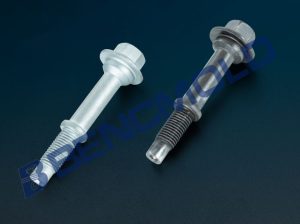
In 2008, a small team of Chinese die makers took on a muffler bolt that nobody was forming in one piece. Six months later it ran on a 134L screw cold heading machine, complete in a single stroke, with a split die at the fourth station. That decision — and what happened to it afterwards — explains more about how we build cold heading dies today than any capability list could.
What made this part hard in 2008
An automotive muffler bolt is a long fastener with a formed head at one end and a profile along the shank that a solid die cannot release. The conventional route at the time was to head the part, then machine the undercut geometry in a second operation. Expensive, slow, and it put a machined surface exactly where the bolt carries load in a hot, vibrating exhaust assembly.
Forming it in one piece meant solving two separate problems at once. The first was the release problem: part of the profile sat behind a wider diameter, so the die had to open rather than slide off. The second was the length. A muffler bolt is slender over a long span, and slender parts bend where the die gives them the least support.
The 134L and the fourth station
The process was built around a 134L screw cold heading machine. The 134L has the long stroke that a part this tall needs — without it the shank cannot be formed in one hit and you are back to intermediate annealing or a second machine.
The four stations divide the work progressively, and it is the fourth station that carries the technical decision. That is where the split die sits. By the time the part reaches station four, the head and the shank body are formed and the remaining work is the geometry that traps the part in a closed cavity. The split die opens in segments around that profile, forms it, then separates radially so the finished bolt lifts out with its undercut intact.
Putting split tooling at the last station rather than earlier is not incidental. Earlier stations do the heavy reduction, where axial load dominates and a solid cavity is stiffer and simpler. The final station does the shaping that decides whether the part can leave the die at all. That is the station where segment complexity earns its keep and nowhere else.
Six months, and why it took six months
Six months of development for one part sounds long until you look at what was being settled. The segment split had to be chosen so each segment could withdraw without dragging across a formed surface. The parting line had to close with no step, because a step means a seam mark on every bolt and a stress riser in a part that flexes. The reduction sequence across four stations had to be balanced so the slender shank did not buckle or drift off-centre before the last station ever closed.
None of that could be copied from a catalogue. There was no reference die to reverse-engineer, because nobody in the industry was running this part in one piece. It was worked out on the machine.
What happened next, honestly
We did not patent it. That was a commercial decision of the kind small die shops made in 2008, and in hindsight it was the wrong one. The process was widely imitated across the Chinese fastener industry within a few years. Many shops now offer a split die for a part like this.
Two things came out of that. The first is that being the original developer became a reputation we did not have to advertise — buyers in the domestic fastener industry learned who had done it first, and that recognition is still why much of our work arrives as a referral. The second is that we changed how we protect process development. In 2020 we finished an optimised split die process for long-length products and applied for patent protection on it. That patent covers the current generation of the tooling.
We tell this story because it is the honest version, and because a die shop that has been copied has had to stay ahead. Fifteen-plus years of iterating on the same problem is a different kind of asset from a certificate.
What the part taught us about cold heading die development
The muffler bolt was the project that turned split tooling from a technique we could use into a method we could repeat. Four things carried forward into how we develop cold heading dies and cold forming processes today.
Decide the release question before the die design
Whether a part can be ejected from a one-piece die is the first question, not a detail settled during detailing. If it can, a solid die is cheaper and stiffer and we will say so. Split tooling is designed in only when the geometry genuinely traps the part.
Simulate the long, slender case
The failure mode on a muffler bolt is not the head or the undercut. It is bending and eccentricity in the shank, where radial support is weakest. We now check the reduction sequence and guide lengths by forming simulation before cutting steel, rather than finding it on the press.
Treat the parting line as the critical feature
On a split die, the fit between segments is the whole game. Segments are wire-cut, then fitted and marked as a matched set. They are not interchangeable between dies, and they ship with their closing ring, because a fresh segment in a worn ring will not close correctly.
Keep the grain flow continuous
Every secondary operation that cuts material severs grain. Forming the complete profile keeps grain flowing through the transition, work-hardens it in the bend rather than cutting across it, and removes the burr and tool-mark risk along with the operation. On a part that sees vibration in service, that is not a cosmetic difference.
Where this applies now
The same approach carries across the range of automotive muffler bolts and adjacent parts: long bolts with undercut profiles, hinge pins and clevis pins with multiple collars, studs where a collar blocks ejection, and exhaust and chassis fasteners that currently need turning after heading.
If a part is described as 汽车消声器螺丝 (automotive muffler screw or bolt) in a Chinese drawing package, the tooling question is the same one we settled in 2008: does the profile release from a solid die, and if not, where does the cavity have to divide. That question sits at the centre of 冷镦模具 (cold heading die and mould) development, and it is decided before any steel is cut.
What to send us
Send the print, the machine model and station layout, the material specification and the tolerance that matters to the application. If the part currently needs a second operation, send that process sheet as well — comparing the existing route against a one-shot route is how we establish whether the change pays back and at what volume.
We develop from wire to finished part: process route, die design, die build, trial and production handover. For how the split tooling itself is designed and built, see our guide to split die cold forming; for wedge anchors, a part with the same release problem and a harder one, see the wedge anchor case. Or request a quotation.
The same development route applies to parts with no standard equivalent. For how we design tooling for special-shaped and irregular fasteners, see automotive non-standard fasteners.
The tooling on that machine is a matched cold heading die set — master dies, second-blow dies and punches designed against one process, not assembled from separate suppliers.