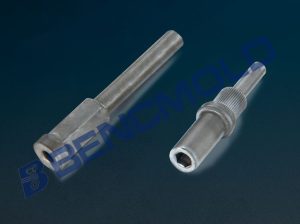
An automotive non-standard fastener is the part that has no catalogue number. It exists because an assembly needed a clip, a clamp, a retaining pin or a specially shaped bolt that no standard part could do — and it usually arrives as a drawing with a tolerance that the application will not let you relax. That is the work we do: developing the cold heading die and the forming process that turn that drawing into a part that runs at production rate.
We are a cold heading dies supplier to fastener manufacturers and to automotive Tier suppliers, and the difference between those two roles matters. A supplier ships tooling to a print. We take the print, decide how the part can be formed, design the tooling around that decision, build it, prove it on a machine, and hand over a stable process. The die is the deliverable; the process is what you are actually buying.
What makes a non-standard fastener hard to cold head
Standard parts are forgiving because the process has already been settled by generations of tooling. A special part gives you no such history, and four things tend to go wrong at once.
The part cannot leave a solid die
This is the most common wall, and it is decided before any steel is cut. If any feature sits behind a wider diameter — an undercut, a collar, a shoulder that steps back down — a one-piece cavity will form the part and then refuse to release it. The answer is not to force it. The answer is to divide the cavity, which means split dies: segments that open radially around the profile, form it, and separate so the part lifts out with the geometry intact.
There is no parent process to borrow from
A standard bolt has a reduction sequence that is known to work. A special fastener does not. The number of stations, the reduction ratio at each one, the annealing points and the guide lengths all have to be derived from the part rather than looked up. Get the sequence wrong and the failure appears as a fold, a lap or an off-centre shank — not as an obvious error you can see on the drawing.
The tolerances sit where forming is weakest
On an irregular automotive part, the tight tolerance is rarely on the head. It is on a formed feature in the middle of a slender section, where radial support is lowest and where the material has already been worked. That is where a die that is merely correctly machined still loses the part.
The volume does not justify a bad process
Automotive non-standard fasteners often run at volumes that are real but not enormous. That removes the usual escape route of absorbing a poor process with inspection and sorting. The process has to be right at the die, because there is no budget in the part to catch it downstream.
How we develop the tooling
Development starts with the release question and works backwards. Before we design anything, we establish whether the part can be ejected from a one-piece die. If it can, we build a solid die — it is stiffer, simpler and cheaper, and we will tell you so even though split tooling is the more interesting sale.
Where the geometry genuinely traps the part, the cavity is divided. The split position is chosen so that each segment can withdraw without dragging across a formed surface, and so that the parting line falls where a witness mark will not sit on a functional face. On a fastener that carries load or seals against something, a parting line in the wrong place is a defect even when the dimensions are correct.
From there the process is built in the same order every time:
- Wire and material. Diameter, grade and the deformation the material will take before it needs an intermediate anneal.
- Machine and station layout. The header model sets the stroke length and the number of stations, and that in turn sets how the work can be divided. We develop for the 104S and 106S, the 134L and the 164L, and the layout follows the machine you actually run.
- Reduction sequence. Balanced station by station so the slender sections do not buckle or drift before the final station closes.
- Die and punch design. Cavity, segments, closing ring, punches, and the special-shaped punch pins that irregular heads and recesses require.
- Build and fit. Segments are wire-cut, then fitted and marked as a matched set. They are not interchangeable between dies and they ship with their closing ring, because a new segment in a worn ring will not close correctly.
- Trial and handover. Proved on the machine, corrected at the die, then handed over with the process sheet.
Tooling scope for non-standard parts
The tooling package covers the full set rather than the die alone. Solid dies and split dies for the forming stations, header punches for the head geometry, special-shaped punch pins for square, hex, Torx and radiused recesses, punch sleeves, ejector pins, cut-off knives and trimming dies. Because the whole set comes from one design intent, the interfaces match — which is where most of the lost time goes when a shop assembles a tooling package from several suppliers.
Wire diameters run from M1.0 up to M33 equivalent, in UNC, UNF and JIS thread systems, at precision grades from G4 to G9. Cemented carbide die cores are ground to G6 or tighter where the application calls for it. Those numbers are the envelope, not the pitch: the reason to send us a part is that it falls outside the standard ranges and still has to run.
Where our process experience comes from
The reason we can make a judgement on a new drawing rather than quote conservatively is that we have already been through the hard version of the problem. In 2008 our team formed an automotive muffler bolt in a single stroke on a 134L machine, with split tooling at the fourth station, at a time when the industry formed that part in two operations. Getting there took six months of settling segment splits, parting-line fit and reduction balance — the same three questions that come up on every non-standard part we quote today.
That project also changed how we protect development work. In 2020 we completed an optimised split die process for long-length products and applied for patent protection on it. The patent covers the current generation of that tooling.
For a part with the same release problem and a harder geometry, the wedge anchor case walks through the decision. For how the segments themselves are designed and built, see our guide to split die cold forming. For standard screws and bolts, the cold heading dies range covers the catalogue side.
What to send us
A quotation is only as good as the information behind it. Send the part drawing with the tolerance that actually matters marked, the material specification, the machine model and station count you run, and the annual volume. If the part is currently machined, cold headed in two operations, or bought as an import, send that process sheet too — comparing the existing route against a one-shot route is how we establish whether the change pays back, and at what volume.
Drawings in Chinese are fine. If a fastener is described as 非标紧固件 or 冷镦模具 in a Chinese drawing package, the engineering conversation is the same one: whether the profile releases from a solid die, and if not, where the cavity has to divide.
Request a quotation and we will come back with a process route and a tooling proposal, not just a price.