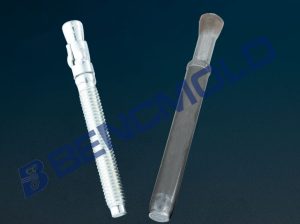
A wedge anchor is unforgiving to make. The expansion cone, the shank and the retaining groove all have to be concentric, or the anchor will not set square in the hole and will not hold its rated load. The traditional route is to cold form the body, then turn the taper end on a lathe as a second operation — which breaks the grain flow exactly where the anchor needs it most.
BENC MOULD forms the whole wedge anchor in one pass on a multi-station cold former, using our own split die tooling. The taper end, shank and expansion retaining structure are all shaped by metal flow inside the die, so no turning operation is needed at all.
Why a split die, and not a solid die
A wedge anchor has a feature no solid round die can release. The expansion cone opens out under the shank, and the retaining groove cuts back in behind it. If you try to form that geometry in a one-piece die, the part cannot be ejected — the die has to be pulled off the part, and it cannot be, because the taper is wider than the shank.
A split die solves this by opening in halves along the part contour. Compressive stress rings clamp the segments shut during the forming stroke, then release so the two halves separate radially and the finished anchor lifts out with its undercut intact. The same principle is what lets us form long, slender parts with multiple collars — the die segments open around the profile instead of dragging over it.
What one-shot forming actually changes
Continuous grain flow through the cone
In a turned taper, the machining cut severs the grain at the transition between shank and cone. The anchor then has a stress discontinuity at the highest-load region of the whole part. When the taper is formed by cold flow instead, the grain follows the contour continuously from shank into cone, and the material is work-hardened through the bend rather than weakened by a cut.
Concentricity held in one clamping
Turning a taper means a second setup, and every second setup is a chance to lose concentricity. Forming the complete part in one die and one stroke means the cone, shank and groove share a single datum. Inner diameter precision on our dies is held within 0.01 mm with high concentricity — a level we verify on profile projectors, vision measuring machines and concentricity gauges before a die leaves the shop.
No turning scrap, fewer operations
Turning the taper end removes material that cold forming keeps. On a long anchor that is a measurable loss of billet per part, on top of the machining time, the handling and the second-machine labour. Eliminating the operation also removes the burr and tool-mark risk that comes with it.
The tooling behind it
This is not a standard catalogue die. It is developed process-first, and that development history is the reason we can do it.
In 2008 we developed one-shot forming for automotive muffler bolts on a 134L screw cold heading machine, after a six-month R&D period, with a split die at the fourth station. We did not patent that process, and it was widely copied across the Chinese fastener industry. In 2020 we developed an optimised split die process for long-length products and did patent it. That patent is the basis of what runs here.
The anchor tooling is built around a 134LL long-stroke multi-station cold former with custom split die tooling. A long stroke is what allows a part this tall to be formed in one hit without intermediate annealing; the multi-station layout carries the progressive reduction across stations so the cone is filled without folding.
Metal flow is checked by forming simulation before the die is cut. With a part this long and this slender, the failure mode is not the cone itself — it is bending or eccentricity in the shank, where the material has the least support. Simulation lets us place the reduction sequence and the guide length so the shank stays true.
How we build the die
Two factories, working as one supply chain. One is dedicated to cold heading dies and fastener forming tooling; the other to punches and punch heads. A complete tooling set — die, punch, sleeve, knock-out — is finished together and shipped together, so the customer does not have to marry parts from two suppliers and hope the tolerances agree.
Across the two plants we run more than 30 sets of precision processing equipment: CNC lathes holding 0.002 mm, cylindrical grinders holding 0.005 mm on the outer diameter, internal grinders for bore and bore taper, wire-cut and die-sinking EDM for the split segments and the undercut geometry, plus multi-directional and surface grinders for the flats and angles.
The split segments are the critical pair. They have to mate with no step at the parting line, or the anchor carries a seam mark and a stress riser exactly where the cone meets the shank. Segments are wire-cut, then fitted and marked as a matched set. They are never interchangeable between dies.
Where this process fits
Wedge anchors are the clearest case, because the undercut is unavoidable. The same tooling approach is what we use for other parts that a solid die cannot release:
- Spring clips, clamps and retaining parts — irregular profiles that need the die to open around the contour
- Long-length fasteners with multiple collars — hinge pins, clevis pins, special studs where the collars would block ejection from a one-piece die
- Special-shaped cold headed components — where near-net shaping beats machining and the geometry has a back-draft
- Heavy-duty construction anchors — where the expansion behaviour depends on the cone being formed, not cut
If the part currently needs a second operation to release it from the die, that is usually the signal a split die is worth evaluating.
What to send us
To quote a wedge anchor or split die project we need the part drawing, the machine model and station layout you intend to run it on, the material specification, and the tolerance that matters to the application. If you have a current process with a turning operation, send that drawing too — comparing the two is how we confirm the one-shot route is actually shorter, rather than just different.
We will come back with the die material, the station sequence, the tolerance we can hold and the tool life you should expect. From a drawing to a running die, the whole process is ours — request a quotation or see our split die tooling range and cold heading die capability.
If your part is not a standard fastener at all — a clip, a clamp, a retaining pin with an irregular profile — see how we develop tooling for automotive non-standard fasteners.
For the carbide grades and fits behind a station set like this, see our carbide cold heading dies range.